There are some words that I will always check. Their spelling or meaning don’t come naturally to me, however many times I come across them. I may not always check them in a dictionary or with someone else. At the very least I’ll do a mental check, usually against one of the rules – “fri- your friend to the -end” or “i before the e, except after a c etc – I’ve made up or filed away to help me remember.
English delights in the various combinations of letters that can produce the same sound – and this applies to proper nouns as much as to other parts of speech. So I always check names also … Stuart/Stewart, Mohammed/Muhammed/Mohamed, Hussein/Hossain, Narayan/Narain, Huw/Hugh, Allan/Alan/Allen, Jon/John, and so on. The best person with whom to check a name is the one who is using it.
Their and there
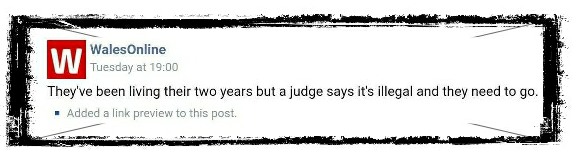
Someone got their spelling wrong in the clip, above, from a British news website. Or, worse, did they just get the wrong word?
“Their” is a possessive pronoun. It refers to people and what they own. “There” indicates place, which is what is meant – and what should have been used – in the article referred to above.
Bear and bare
The key thing here is to remember that “bare” always refers to emptiness or the absence or lack of something… the cupboard was bare (empty), the ground was bare (nothing growing on it), her bare hands (no protection on her hands).
“Bear” on the other hand has a couple of meanings. It can be used in the contextt of carrying or moving or transmitting something: “I bear this burden with humility”, or “I come bearing gifts”. It can also be used to describe a plant, animal or human reproducing: “The tree will bear fruit in time”, or “She bore three children during her marriage”. It is also the animal hero or culprit of many a tale, from authors such as Rudyard Kipling or any walker carelessly intruding in their forest habitat.
Bated and baited
We often see the phrase “waiting with bated breath”. It means someone was anxious or excited or nervous as they waited for something to happen. “Baited” means there was some kind of food on a hook or in a trap to attract and catch a quarry. “Bait” can also mean something that is used to lure or trick someone into doing something.
Check and cheque
If you “check” something, you examine it for quality and usefulness. A cheque, in British English, is the printed form on which a person can write in the amount they want to pay someone. The receiver can exchange that cheque at a bank for cash. Americans use “check” for that document … and for when they examine something.
Faze and phase
Faze means to disturb or shock, usually used, it seems, in a negative sense as in “She wasn’t fazed by all the interruptions”, or “The criticisms hardly fazed him”.
A phase is a particular period or stage in a process. You could say, “Her worst performance was during the swimming phase of the triathlon”.
Horde and hoard
Horde refers to groups of unruly people (often doing something we don’t quite agree with). “Hoard” can be either a noun or a verb. As a verb it means to store up (often in the sense that the store is more than necessary). As a noun it describes a store or collection of something.
There is also another word, hoarding, a noun which describes a large board or display on which advertisements are shown. It can also mean the fencing around a building site
Llama and lama
Llama is an animal), originating in South America, and at one time providing the basis for many a financial scam. A lama is a Tibetan Buddhist priest.
Site, cite, and sight
“Site” is a place or location: “This was the site (noun) of the massacre”. It is sometimes used as a verb: “You can site it here”. But that usage is usually in a technical or specialised way, for example, when someone is talking about a new building.
“Cite” refers to quoting someone or something, especially as proof of your claim. A citation is when you give details of where you found the information you are using.
“Sight” is the ability to see. “His sight was damaged in the blast.”
Stationery and stationary
There’s a little trick I always use to remind myself of the correct word to use: An envelope, which starts with an e, is stationery. If I’m not referring to envelopes and related articles – pens, pencils, paper, ink – used for writing, I’ll use “stationary” which does not have an e for envelope. “Stationary” is used to describe something that’s not moving – stationary traffic.
Story and storey
A story is a tale, a description of things that have happened. A story can be fictional or true. The plural is “stories”
Storey describes a floor or a level of a multi-level building (plural storeys)
 Whatstheword