
Every time we want to use an apostrophe, we should stop – just like the person who made this sign should have. We should think about it, keeping our fingers well away from the apostrophe key. We should consider whether we want to change a singular into a plural, whether we want to shorten a word, or whether we want to show possession.
If we want to make a singular into a plural, forget the apostrophe.
If we want to shorten a word by dropping a letter or two, or if you want to combine two words (and drop a letter or two), or if you want to indicate possession, you should use an apostrophe.
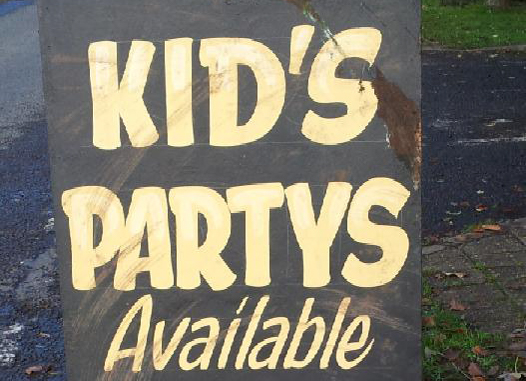
One kid or more? (And ‘parties’ or ‘partys’?)
Dates
Don’t use an apostrophe unless you’re leaving a number out. There is no apostrophe in 1960s or 1970s, or 2020s. But there can be in ’60s and ’70s where the “19” has been left out
Plurals
Never use an apostrophe to indicate a plural. A bull is a bull, but if there are two of them, it’s bulls, not bull’s or bulls’.
Possessives
The rule can be complicated, but the apostrophe is used to indicate possession, and its position indicates whether something has one owner or more than one owner
If you write
The farmer’s cows were grazing
your readers should understand that you are discussing one farmer and his cattle.
If you write
The farmers’ cows were grazing
your readers should understand that you are talking about the cattle belonging to more than one farmer.
But remember that pronouns – whether they are personal or impersonal – don’t take an apostrophe to indicate possession.
Examples:
That ball is ours
This ball is hers
This ball is yours
That ball is theirs
Its and it’s
The possessive form of the impersonal pronoun it and the contraction it’s also cause confusion. The only time you should use it’s is when you mean to say “it is” (when you are joining it and is). The possessive form of “it” (its) does not have an apostrophe.
Here’s a case of the apostrophe being used wrongly: “We have rain coming in from the west with snow on it’s leading edge.”
A good way to check if you are using the right word is to see if “it is” can replace “it’s”. If it can’t, it’s the wrong use of “it’s”
Lets and let’s
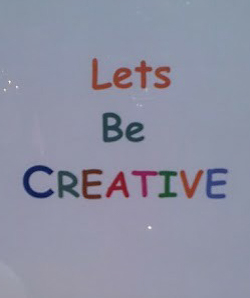
“Let” implies permission: “Bill let Peter swim at the deep end of the pool”, or “I will let you have this coat if you promise to look after it”
“Let’s” is the joining together of “let” and “us”
Sign in a bookshop … more error than creativity

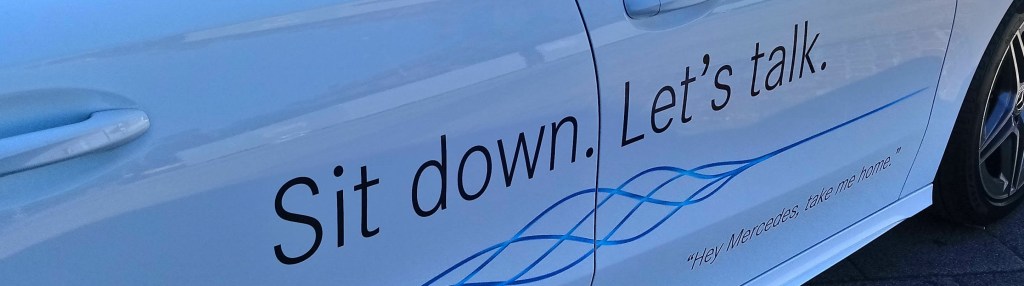
Where’s the apostrophe? The correct version, below, is from the same promotion
Contractions
You may have seen the word “never” slightly shortened by its “v” being dropped, as in “Ne’er the twain shall meet”, or in “ne’er-do-well”. The apostrophe in ne’er is there in place of the “v”.
In more informal language, some examples include
“I will” becoming “I’ll”
“you have” becoming “you’ve”
“he will” becoming “he’ll”
“he is” or “he was” becoming “he’s”
and,
“he had” becoming “he’d”
Other examples include you’ve (you have), let’s (let us), didn’t (did not), don’t (do not)
Get in touch if you’ve seen examples of a dodgy use of an apostrophe
 Whatstheword